Sunday, 14 July 2013

French bed

100. French bed.

My hundredth object is the bed that we sleep in, yet another example of something that has migrated to England from abroad. It was bought from The Old Pickle Factory in Bristol from a company that imports and restores period French furniture. The word 'restore' tends to mean a fashionable application of one of Farrow and Ball's light, chalky paints and we were eager to find a bed before it had received such treatment. One of Peter's former pupils worked with the company and we told him what we were looking for, a flowing Rococo style of centered design with some deep carving. He said that he would keep an eye out for us.
We made several forays into town when new stock arrived, but without success. Then I found a bedend amongst a stack of wood. "This is just the sort of style we're looking for," I said, "If only it had a headboard."
"It's here somewhere," was the reply, and it was! It has a central carved shell design and swags of roses. Surely it was destined to be mine! The wood, I think, is walnut. It does not have the grandeur and history of the half-tester bed that I was born in, but it is comfortable and very pretty!

FINIS

Saturday, 13 July 2013

Portrait - work in progress


97. Portrait studies by David Ferguson.

Three years ago I sat for several days to have my portrait drawn and I've been waiting patiently ever since to see the finished result. There is no point in hurrying or badgering the artist because he works at his own particular pace, in a process of application and removal, until he feels that he has said all that is possible. It fascinates me that as his images recede the character gains clarity. His art is of reduction and subtlety.

In April we took a short break to Cornwall to see how the portrait was progressing. Would we consider the work finished? Would it then be necessary to wrestle the picture away from him? Would I even like the look of it?
Paintings were stacked against the walls of his studio and a handsome framed portrait of another sitter was displayed on the easel. A beautiful face, beautifully painted.

David had studied at the Slade under William Coldstream, whose rigorous observation and painstaking method he employs. The dimensions of my head had been carefully noted, by means of artists' calipers, during the initial sittings. On this visit he asked me to take the same pose. "You've changed," he stated. I allowed myself a small smile but didn't state the obvious, that I am three years older. A Dorian Grey moment! I was pleased to find that he was working on two studies of my head and shoulders in different formats, one portrait, the other square. he took the framed work down from the easel and displayed the larger piece, the portrait format.
I was looking at my mother!
For the sitting I had worn a grey linen dress because the colour was neutral and the style simple, exposing shoulders and collar bones. But when I looked at the dress in the painting it took on a greater significance. Every year throughout my childhood my father had bought me a party dress. It had been his pleasure to take me into town to choose something lovely. After his death I cashed in an insurance bond that he had taken out at my birth and spent the money on the grey dress. When I brought it home my husband said, "Your father bought you that dress." How pleased I was to have worn it to the sittings.

I have shown these photographs of the two pieces of work in progress to artist friends and am surprised by their reactions. "It isn't you," they said. "He hasn't captured your liveliness." They see me most often in company when I am noisy and opinionated. This, I think, is what they mean by lively.
"I wouldn't want him to paint me!" said one.
But when members of the family look at the images they see both my mother and me, captured clearly.

98. Carved ebony 'crocodile' 25cm length.

This is just one of many small tourist carvings that we bought on holiday in Kenya over a quarter of a century ago. I had no idea at the time of purchase that it would prove to be such a useful object. It has been in almost daily use ever since, positioned on the piano just beyond the kitchen door within easy reach when we open the morning mail at the kitchen table. The crocodile is not only a humorous- looking object, it is also extremely well designed, fitting comfortably into the hand, the tail slicing neatly and efficiently through paper envelopes. Opening post without it feels a messy and unsatisfactory business.

99. Headstone for a dog. Sleeping lamb, concrete.

As a small child the first dog that I chose and called my own was a miniature black poodle. Because the breed was of French origin I called her Michelle, many years before the name was made popular by the Paul McCartney song. She was the perfect companion for a little girl because she was intelligent and responsive to teaching and had a curly coat that required endless grooming and styling. I was broken- hearted when she died. My father buried her in the garden and made the concrete lamb to mark her grave. It has traveled with me to various homes and been a marker for much-loved pets. It is not wearing too well, having lost a fair amount of definition over the years!
Now it is placed beneath the walnut tree in the garden of our present home and marks the grave of my adored smooth fox-terrier, Maisie. It was one of her favourite places to bask in the morning sunshine while keeping an eye on me as I worked among the vegetables.


Saturday, 2 February 2013

Portrait

96. Portrait (detail) by Deborah Pye
oil on gesso

During the years that Peter was teaching I went to the end of year degree shows. At one of these I admired the work of Deborah Pye and commissioned her to make a portrait of our elder daughter. The two girls were only a few years different in age and when Debbie came to the house I left them to their own devices. In time Debbie produced a painting that she considered finished. It did not resemble the paintings that she had displayed at her degree show. She had tried too hard to make something that she thought would please us and not what she would want for herself. It was suggested that she rework the painting to her own satisfaction. When she returned with the painting as it is now we were all delighted.
This painting tells me a story. Our daughter sits on her bedroom floor but looks away from us, gazing out, beyond the walls. She is ready to 'fly the nest'. A couple of months later she went away to university and on to her own life, since when she has returned home only for short visits on high days and holidays.

Tuesday, 29 January 2013

Decisions, decisions


So few spaces left and so many possible objects to choose from that I have ground to a halt. I sat for a portrait about three years ago and, whenever he finishes it, it will be included in the list. We phone Cornwall every now and then to see if it is ready to be collected. A month or two hence is always promised but never gets any nearer. I'm holding the space!

First sitting.

Thursday, 20 December 2012

Tags.

94. Brass dog tag.

This tag was bought by one of our daughters for Bella, the first smooth fox terrier that I owned. On the reverse it is inscribed with her name and our telephone number. After Bella's death her relative, Maisie, took ownership of the tag with a promise from me that once she had learnt to read I would buy her a new one and put her name on it.
Maisie was my constant companion for ten happy years. She never learnt to read but she was adored and adoring and possessed a heart of gold.

95. Infant identity tag.

This small plastic hospital identity tag changed my life for ever. It turned me into someone else, a mother.

Thursday, 2 August 2012

92. Dustsheets

92. Dustsheet.

Whilst I enjoy being away on holiday I am always happy to return; I'm a home bird at heart. Since my marriage we have always lived in old houses and have become adept at making alterations, with walls down, doors moved and decorative colours carefully chosen. I have some of my father's dustsheets, stenciled with his name. They have seen a lot of action over the years, not only with our own projects but before that in my childhood home, which my father had designed and built. His dustsheets were often in use because he was constantly engaged in new decorative ideas and 'improvements'.

Inevitably the dustsheets have become blotched with marks over time. There are small spots of colour that act as a trigger to memories; rich ultramarine, a reminder of the dining room in an earlier home and a deep red brown that recalls a front door. Dustsheets are such useful things, and these, which must be well over seventy years old, are of wonderful quality. The family association is precious to me. I wash them and treat them as though they are cashmere blankets!

93. Garden trowel.

My elder daughter made this trowel in her craft lessons when she was a schoolgirl. It is still going strong! I spend a great deal of time in my garden grubbing about in the soil and have a motley collection of tools, some more useful than others. For obvious reasons the is the one that I handle with the greatest care.

Thursday, 19 April 2012

"Leaving Home," limewood carving.

86. "Leaving Home" Limewood carving by Peter Murphy.

I never intended to leave our previous home."You'll have to carry me out in a box," I said on more than one occasion. We were living in an old farmhouse with a large, overgrown and magical garden. It was very similar to my childhood home. "You've bought 'Coruisk'" my father said when he first came to see what we had let ourselves in for.

To the south and east beyond the garden lay an orchard and fields. To the north there was a small hill of oak and ash trees that protected us from harsh weather, creating a micro-climate that enabled me to grow buckets of tomatoes and plentiful 'Sweetheart' melons. Close to the rear of the house a long stone wall had been built to protect us from a new road that marked the boundary to an ever-growing satellite town.

All the family was captivated by the garden. For the children it was a space to run, swing and climb, to camp on the hillock with friends, to loll in the hammock strung beneath the massive fir tree on the lawn. Peter converted the pig house into a small carving studio, put in a workman's stove and reappeared only for meals when I rang the bell that hung outside the kitchen door.
I gardened, in the long conservatory that led off the sitting room, in the flower borders, the vegetable garden with it's old fruit bushes and on the sunny banks of the hill where the slow worms loved to bask.

The space around us became a source of our art; paintings and drawings, woodcuts and carvings. The carvings in particular recorded the pattern of our lives whilst living there.

Then the town boundary was altered. In spring, when the neighbouring orchard was in full, glorious bloom, diggers came and wrenched out all the trees. A national firm had bought the land for a housing development and our dream home was at an end. They built tight to our border, wrecking our drainage system in the process and causing un-imagined grief. After two years of disputes we were relieved to leave.

Peter made this carving once we had moved house. It is a farewell. Although we had physically left the farmhouse it took me a good year to say goodbye, I mourned for what had been. But I had been taught some valuable lessons; that nothing is set in stone and that it is best to be flexible and enjoy the present, for who knows what tomorrow may bring.

87. 1950's Aga cooker.

The buyers of our farmhouse had no interest in keeping the Aga - did we want to take it with us? What a question! We employed a man to come and move it for us. He was as squat and solid as the cooker, with hands as large as the hob lids. He moved the Aga with great skill, and seeming ease, out of the kitchen and through the door by means of a few wooden rollers. It sat in the garage of our new home for a while until we had rearranged the kitchen, having to knock down a wall to accommodate it. Once it was in place our small cottage started to feel like home.

Quite apart from cooking, an Aga serves a variety of purposes, airing clothes, drying kindling/hair/wellingtons/dogs - you name it! It provides a constant, comforting level of warmth. I have been cooking on this Aga for well over a quarter of a century. It was converted to oil when we moved house so that now it is rather expensive to run. But I think that it is well worth it, and the dog agrees.

88. Hungarian dresser.

The fitted furniture could not come with us from our previous home and replacements were needed. My old built-in kitchen dresser had open shelves and all the glass and crockery had to be regularly taken down and washed. I wanted it's replacement to have glass-fronted doors to keep the contents clean.
We searched for a while before finding this dresser, in a rather forlorn state, brought from Hungary in a van, one item of many to be patched up and resold. It makes me smile because, although crudely made, it has pretensions of grandeur, with it's fluted columns and decorative details. The feet were worn and uneven as though it had previously been standing on an earthen floor.
Now china stays clean behind the glass doors and the capacious lower cupboard stores my heavy crockery. There is a bread slide, a useful pull-out shelf. I would love to know the history of this furniture, what items formerly sat on the shelves and what sort of dwelling it came from.

 
89. Hungarian wardrobe.

Rummaging amongst imported furniture that was stored in old farm buildings awaiting restoration we found a couple of wardrobes. I personalized the one in our bedroom by painting on the door panels and adding a poem by Robert Herrick. It seems very suitable for a room where we drift into unconsciousness each night.

Here we are all by day
by night we are hurled
by dreams
each one into a several world.

Robert Herrick,  1591 -1674.

I suppose that this piece of furniture is now anglicised and in the future people will look at it and scratch their heads!

90. Antique French chandelier.

It is interesting how some goods travel from one country to another. What is considered old-fashioned in one place may be highly desirable in another. Things disregarded in France have long been coveted by the English.
I wanted a light fitting for the sitting room, nothing too flashy, but a bit special none-the-less. Chandeliers have become very popular but new ones can look outrageously shiny. In an antique shop I found this old French fitting looking suitably 'shabby chic', with it's dark metalwork and slightly wonky crystal drops. I love it!


91. "Keeper's Cottage." Egg tempera painting by James Lynch.

James was commissioned to paint a portrait of our cottage for my sixtieth birthday. He is a keen hang-glider and the subjects of many of his paintings are seen from a bird's-eye view. Because of this we erected a scaffolding tower at the edge of the lawn. He sat on a chair atop this in nonchalant fashion, sketching and making notes. He went away with this information and several weeks later phoned to ask, "Do you want me to include the house next door?"
"Not really," I replied, so he used a degree of artistic license.
In reality our cottage sits in the centre of a small hamlet, but in my head I live joyfully surrounded only by nature.

Saturday, 4 February 2012

Leedsware

84. Leedsware dish

This badly damaged piece of old Leedsware, cracked and minus its handles, sits on my kitchen window ledge. It holds an assortment of broken clay pipes, a collection that grows with each year as I dig and unearth them from the vegetable garden. The dish, of cream earthenware, is very probably of an age with many of the pipe pieces, as the pottery was begun in 1770 by two brothers and closed in 1878. Their work was famous for embossing and for pierced openwork, as my example shows. The openwork was created by hand with a variety of small tools.
The dish belonged to my father, who was a Leeds man. He didn't mind that the piece was in such a poor state, he could appreciate the work that had gone into making it and he still considered it beautiful.

85. Modern Leedsware mug

Moulds and pattern books from the old pottery had been preserved and in recent times
'Leedsware' earthenware was reintroduced - made in the Midlands! It should really be described only as creamware. I  bought this mug as a present for my father but the craftsmanship is only a dull echo of the original work.


Sunday, 29 January 2012

Souvenirs

81. Venetian mask

I have bought many souvenirs, over the years, from Venice, my favourite city. The earliest purchases were of shoes, bought from small shops that sold custom and ready made shoes of the softest, jewel-coloured leathers. Sadly the shoemakers have now gone, but many other skills survive. The pleasure of shopping in Venice is that craftsmanship is still alive. In back rooms the paper makers, framers, glass blowers and mask makers are all busy producing their goods, skills passed down unbroken through the generations. Like every other tourist I have bought my fair share of embroidered and initialed handkerchiefs and mementos of Murano glass.
As well as sunshine we've also experienced a fair amount of rainfall in this city of water and one year we came home with an extremely large and elegant gentleman's umbrella. It was not remotely British, the fabric was a rather racy navy with brown spots and each metal spoke was tipped with wood to match the handle.
Now the city is awash with tourist tat, imported fabrics that are a dull echo of the work of previous years. Masks are big business. They vary from the traditional to the revolting to the magical. I bought this blank to decorate myself. It has been hanging on the wall of my workroom for years, a quiet presence, with a teardrop moulded into the papier-mache. Initially I had some complicated idea as to how I would paint it, but now I like it just as it is and it will remain unadorned.

I am usually disdainful of holiday souvenirs, but can hardly be so about those from Venice, after all I have bought so many! Half masks and full masks, vases, glass sweets and jigsaws, water carafes and ice-cream sundae dishes, the latter stretching my Italian vocabulary to the limit but improving my miming skills considerably.

82. Jigsaw of the Palazzo Pesaro-Rava.

Venice is a place for moving slowly, on foot through the myriad small alleyways, by boat up and down the canals. It gives a pace for looking, observing more closely, discovering all manner of small pleasures, the sounds of footsteps that have not been obliterated by the roar of car engines. You stroll along the same streets each day, you linger in a shop doorway, and you are tempted. It isn't possible to buy the Palazzo Pesaro-Rava, so beautiful on the Grand Canal, but you can take home the jigsaw that bears it's name.

83. Classical casts.

A ramshackle wooden box, bought years ago at auction for a few pounds, holds four layers of these delicate small casts, souvenirs from an era when people embarked on the 'grand tour'. They brought these items home as a reminder of the works of art that they had seen on their travels through Europe.


An old German book, 'Gemmen und Kameen des Altertums Etder Neuzeit' helped me to identify much of the subject matter and the source material.
Some of the pieces had perished and Peter set to work to reproduce the remainder whilst they were still sound.


Moulds were made, after which the fun really started. What materials to cast in, and what colours to choose? We made a mixture of resin, marble dust and pigments and worked alongside examples of different stones to imitate their qualities.


We were delighted with the results and had several pieces made into jewellery. We thought that we could sell these. 
We couldn't ! Our skills didn't extend to commerce, or any ability to make money. After the pleasure of making durable copies, followed by designing a letterhead and leaflet, our enthusiasm and salesmanship faded and our little gems were put away in a cupboard.


Stick to what you know!

Sunday, 22 January 2012

Ivory figures

79. Japanese entertainers
ivory, 4 cm high.

I handed over my father's collection of ivories to my nephew several years ago and then saw this beautiful little object in an art gallery while Peter was looking for something else. The man's toe is broken. I had picked the piece up by the clear perspex base, thinking that the figures were attached, but no, they were not, and the figures went flying, so the missing  toe is down to my own clumsiness. I was delighted to buy this ivory and bring it home, it is a pleasure to put in the palm of my hand and study closely, each small detail of the patterned clothing, the ribbons beneath the chin. My father would have enjoyed this object and my buying it feels like a continuation. Our daughters are the same, the younger tells me, "we don't do tidy, Mum, we're too fond of stuff."

Thursday, 19 January 2012

Street cries of London


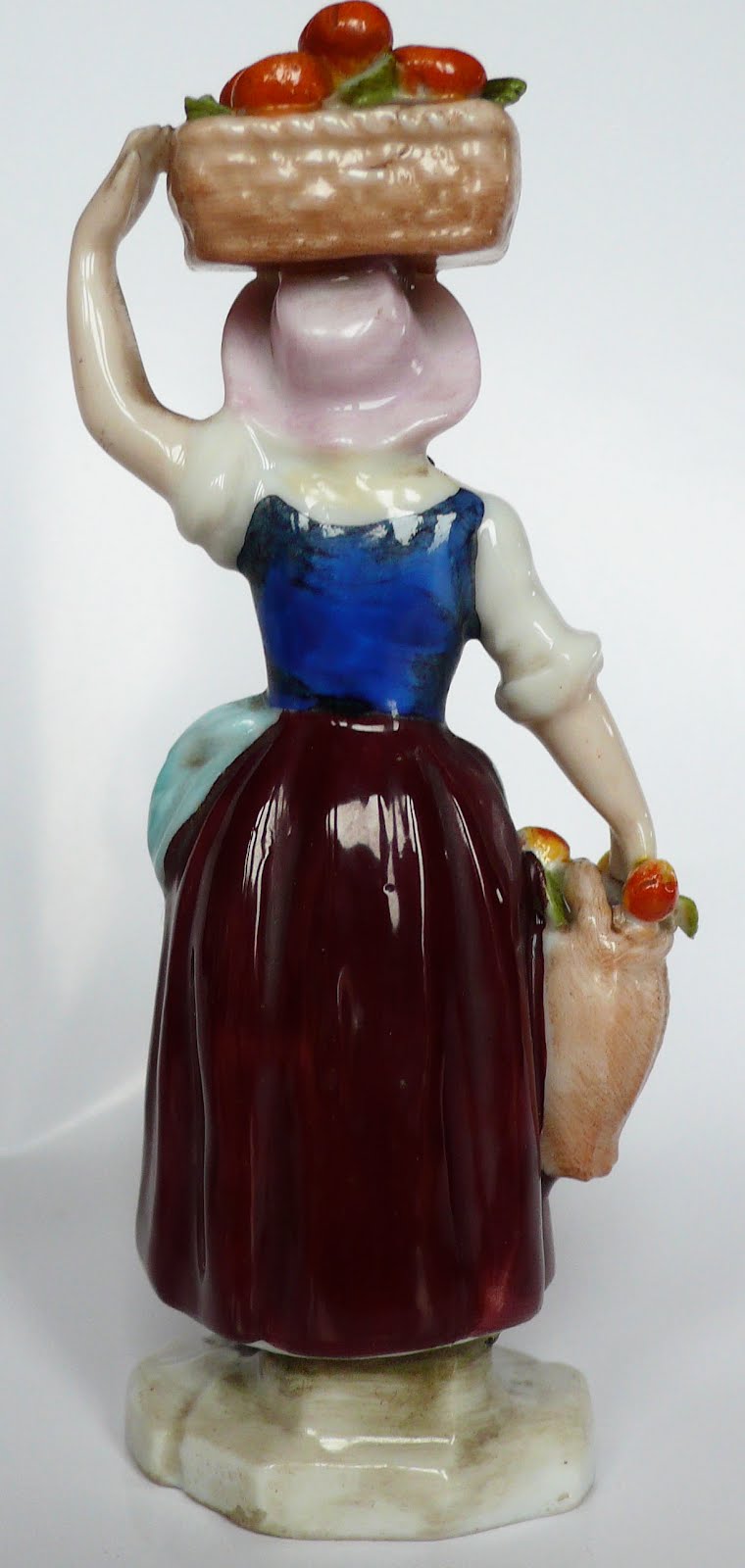
78. Street cries of London figurines
8cm high.

Some time before the luxury of having a hamper delivered from Fortnum and Mason, produce could be bought on the streets of London from the many sellers, each with their own distinctive call.  They are a popular subject matter for small figurines such as these.


Thursday, 12 January 2012

Hamper

77. Fortnum and Mason wicker hamper.

On the morning of Christmas Eve a few years ago a courier struggled up the garden path with a large present for me. Oh, joy - it was a hamper from Fortnum and Mason, absolutely packed with goodies! The family and their partners were arriving later that day so I opened the hamper on the kitchen floor and examined the contents. There was everything that a hostess could wish for to add to her celebratory meals. 
We were feasting all week!
The hamper has been re-stocked and taken on various outings since then, the F&M logo adding a bit of style to happy occasions!

Nativity set

75. Pottery nativity set

We bought this nativity set many years ago, in the week before Christmas, from a pottery in the narrow streets around Palma cathedral. Its simplicity is charming, the sheep made from just a squidge of clay with four nails for legs.
Several years after having bought it my parents took our elder daughter to Majorca to recouperate from a serious illness. She was ten years old and insisted on an expedition to the pottery, although she could not remember exactly where it was. My parents told me later that it took a lot of finding!
They bought this black and white Spanish bull to add to our nativity set.

76. Boxer dog.

And because my own childhood had been spent with a faithful boxer dog as companion my father bought me this dog as a momento, (although Bruce was a brindle boxer and an altogether more solid character!)


Monday, 12 December 2011

Hungarian rack


74. Hungarian rack.

When we moved to our present house we did the usual thing of re-arranging several walls and doorways. When the chaos was over we bought the house a present of this Hungarian shelf and rack. It hangs in a space created by the removal of a door.

It has a wonderful patina of age, with the date 1882 barely discernible in the faded paintwork. The decorative flowers and patterns will once have been bright and colourful.

The importer who was selling to us asked if we wanted him to do some restoration work on the piece.
"NO" was our immediate and horrified response.
This practical object  has a celebratory feel and was probably made as a wedding gift. Now it celebrates a happy retirement. It is barely visible beneath a collection of coats and hats, dog leads and umbrellas.

Darning mushroom

73. Darning mushroom.

I inherited this sycamore darning mushroom from my mother-in-law. She was a demon knitter and the only female in a household of males. She knitted socks and jumpers, scarves, hats and gloves. Her husband and sons must have given her handiwork quite a bashing because the surface of the mushroom is pitted from years of use. It is a satisfyingly practical object, the wood is light and comfortable in the hand, far superior to the ugly plastic mushroom that I used before inheriting this.
I was taught to patch and darn at school, a place described as being for 'young ladies'. What do 'young ladies' care about patching and darning? Very little, I can tell you! We had to practise these skills on small squares of fabric. How pointless and time-consuming it seemed. I was marked 0.5 out of 10 for all my effort.
My heart still sinks when I discover a small hole and know that I shall have to get out the darning mushroom and set to work.

Thursday, 8 December 2011

Embroidery


72. "Bella in Heaven"
silk embroidery by Janet Haigh.

I was brought up in a household that always included one or two dogs, but I married a man who quite definitely did not want to share his home with one, so that was the end of that. But when my father died, at the start of the new millennium, shortly followed by his faithful old spaniel, I was bereft. The only solution was to buy a dog of my own. Bella came from a breeder further down the dale, and for me, at least, it was love at first sight.

Love poem.

I have a new love.
Her greeting melts my heart.
Doe eyes, kohl-rimmed and gentle
her presence in our house experimental.
"Besotted," says my husband,
and he's right.
He'll not be charmed without a subtle fight
of wagging tail and wriggling with delight.
"That bloody dog," he says
of mud across the floor
and hairs on clothes 
and half chewed bones.
But I am charmed,
and every little chore is worth it
for my own first dog,
fox terrier,
whom I just adore.

Bella met an untimely death, chasing a cockerel across the road. I was heartbroken. My friend Janet, the owner of two wire-haired fox terriers, dyed a large square of silk into beautiful colours. She embroidered Bella, complete with a pair of wings, in the centre of this silk heaven. Her inspiration came from the Bedlington terrier paintings of Craigie Aitchison.
I felt that Bella looked lost in so much space (how rude of me) and Janet, wonderful friend that she is, let me mutilate the silk by cutting it down to make a dainty icon of her work.
This embroidery is precious to me for many reasons.

Bella in Heaven

When Bella died I cried
while Janet stitched my little dog with wings
and dyed a piece of silk bright green
for heaven.
There she stood, with matchstick legs and neat brown head
waiting to play in her silk heaven, generously large,
a gift of sympathy and love.
But in this space she looked too much alone
and so I asked, "Please can I cut her heaven down?"
Now my small dog stands square in her own patch,
the boundaries marked out in wood and gold,
happy in heaven, never growing old.

Sunday, 20 November 2011

Enamel flowers


70. Flower brooches,
enamel on copper, by Janet Haigh.

The embroiderer Janet Haigh, makes the most beautiful objects, and her enamel flower brooches, in a myriad of delicious colours, are irresistible. The enamel is fused onto copper and the small glass beads stitched into place with wire thread. The pleasure in owning and wearing these brooches is intensified by knowing that they have been made by a friend.


71. Heart badge,
 enamel on copper, by Janet Haigh.

A firm fabric knot mends this broken heart. The significance of mending is an important theme in Janet's work, and this colourful little badge is very meaningful to me and to the friends for whom I have bought a similar heart.

Thursday, 13 October 2011

Flower vase

69. Strathearn glass flower vase,
green and blue with copper aventurine inclusions.

This vase was a wedding present to my parents in the 1930's. My mother rarely picked flowers from the garden but it is something that I have always enjoyed.  The fluted rim provides a wonderful structure for holding and displaying whatever motley collection of flowers are placed in it. It fulfills the tenet, 'form follows function'. This vase was such a favourite of mine that at my own wedding I was given a large, green Strathearn glass vase of my own, a present from my much loved Auntie Ann. The rim of that vase is unfluted and does not display the flowers so well.
Some years ago my mother gave me her own.  


Sunday, 25 September 2011

garden book


68. 'Simple Fruit Growing' by P.K. Bear.

This much-thumbed little book is very precious to me, but not for any of the advice given within its covers. It is printed on rough, dull cream paper, "produced in complete conformity with the authorised economy standard". 

My father bought the book in 1945 when he was discharged from the army at the end of the Second World War. He filled the blank frontispiece with the names of all the roses that he had bought to make a rose garden. On the end pages he made a record of the fruit trees, planted over several years, that became our orchard.
It was a magical place, underplanted with spring bulbs, the long grass scythed only a couple of times a year.  When I look at the names that my father has written I am transported back to the orchard, my favourite part of the garden. I remember the different trees well, 'Egremont Russet',  'Ribston Pippin', the 'Irish Peach', the hard 'Pitmaston Duchess pears, and the cherries that the birds ate the minute they were ripe.
 
Eating cherries, 1950's.